The kingdom of heaven is like treasure hidden in a field, which a man found and covered up; then in his joy he goes and sells all that he has and buys that field.
Matthew 13:44
What treasure do you suppose Jesus is referring to? I just read an article from a religious academic that said the treasure is Jesus Christ and the salvation he offers. Such an idea would have been foreign to Jesus. Based on evidence we glean from the mystical thread, the treasure represents a fully active spiritual dimension, the understanding of which would immeasurably enhance the quality of one’s life. Gaining this understanding requires total commitment, but, because the man understands its value, he pursues it in joy.
We’re told the man, in his joy, sells all that he owns so he can buy the field containing the treasure. Compare this attitude of joy to another instance where Jesus advises a rich young man to sell all his possessions, give the money to the poor, and then follow him. This is a depressing notion to the young man.
The difference in these two cases is that the man who discovered the treasure grasped its value on his own. He saw that the field and the treasure it contained was worth more than all his possessions, so in joy he could release the lesser for the greater. The wealthy young man, on the other hand, was simply responding to the instructions from another. He placed more value on his possessions than on the thing he hoped to acquire. In other words, his quest was conceptual while the other man’s was experiential.
With the theme, our journey home, we emphasize the need to make the spiritual quest our very own. In the beginning we are prompted by a pristine urge to know and experience something deeper than we have been taught, but we can easily slip back into following the advice of respected books and teachers. While these have their place, we should never forget that we are being guided by our own spiritual comforter and advocate. This is what brought us to the treasure-bearing field in the first place.
There is something to be said for the increased level of morality that religious training inspires in people. For some, however, the motivation to do good is often driven by fear of the consequences for doing otherwise. For centuries, the church has used the fires of hell as a means of keeping their flocks on the straight and narrow. On our journey home, the time comes when we take a deeper look at the ideas we’ve been handed.
It should come as no surprise that Jesus had a different take on God and the notion of sin and punishment. God does not react to human behavior, good or bad. “… for he makes his sun rise on the evil and on the good, and sends rain on the just and on the unjust” (Matthew 5:45). This statement is a clear contradiction to religion’s depiction of a capricious God. Our journey home begins with a healthy understanding of God. As Mark Twain pointed out, “It’s not what we don’t know that gets us in trouble. It’s what we know for sure that just ain’t so.”
While our understanding and attitude toward God can change many times, God is changeless. The purpose of meditation is to sensitize the mind to the point where we can observe and experience the subtle presence of God as the living energy from which our being rises. St. Frances of Assisi suggested this when he wrote, “What you are looking for is what is looking.” Such direct exposure not only clarifies our understanding of God, it also sets us on the highest moral path.
We are under no obligation to settle for depictions of God filtered through religious institutions and professionals. These only pass on ideas that have been handed to them through so many generations that they treat them as truth and probably believe them to be so.
To love the lord your God is to seek direct revelation from within the “inner room” of your own being. It is up to each one of us to separate truth from fiction, to come to know our own indwelling lord as the advocate and comforter that is with us always.
“Do not be deceived by dimples and curls. I tell you that babe is a thousand years old.”
Ralph Waldo Emerson
We began our life on earth with an innate curiosity toward the world around us. As our senses developed, we found we had a natural attraction to colorful objects and fuzzy things that squeaked when squeezed. Later, we would gaze into the night sky and wonder where, amidst that vast expanse, we fit in. It may have been sometime later that we began to wonder how and why we came to be in this place.
In my own quest for understanding, Emilie Cady’s illustration comparing the soul to a pail of water drawn from the ocean made a lasting impression. She focused on the composition of water, using it to suggest that the soul shares the same elements as the cosmic ocean from which it is drawn. The illustration takes on an even more profound meaning when we consider the age of water. According to science, regardless of when a pail is drawn from the ocean, the age of the water remains 4.6 billion years. The water in the pail does not evolve to become as old and as wise as the water in the ocean. It has never been and will never be anything less.
The implications of this illustration present us with a spiritual model that raises significant new questions. If our soul is as complete as our spiritual source, then what is the objective of our quest? The short answer? Spiritual recovery – conscious recollection of who and what we are at the spiritual level. We are seeking a clearer understanding of how a spiritual being, equipped with a material interface in the form of a body, can best travel through this earthly experience with the deepest sense of meaning.
The best way to start this inquiry is not with an answer, but with a couple of questions. How and why did I come to be in this place? Am I here as the result of forces beyond my control, or am I here by choice? Am I here to simply collect more colorful objects and things that squeak, or did I choose to come, having a specific purpose in mind?
Search the world’s literature and you find affirmative support for both perspectives. However, it is your answer, your understanding that determines the way you approach your journey home.
“Do calmly, without excitement, whatever the circumstance seems to require. This will lead to the further unfolding of other circumstances in the same direction. By addressing each one as it appears, you are moving step by step toward the accomplishment of your desire.”
Life is all about transformation. A seed is dropped in the ground in one form, and it emerges as another. And, “unless a grain of wheat falls into the earth and dies, it remains alone; but if it dies, it bears much fruit” (John 12:24).
So it is with the manifestation process. In a very real sense, this process is about dying to one state of being so that another may come forth. As you move from where you are to where you want to be, you must release the old and take on the new.
Watching the new emerge is an exciting process. When you see evidence of your desire beginning to manifest, it is easy to become overzealous in your attempt to hurry things along. External action can be addictive. Things begin to happen, and you want them to continue so you may start trying to “push the river” as someone put it. The writer of Psalms also warned against overzealousness when he wrote, “zeal for thy house has consumed me” (Psalms 69:9).
Every step toward your desired good offers something of value, even in those times when nothing seems to be happening. Hold your vision in an attitude of expectation, enthusiasm and in the knowledge that everything is working together for your good in right and perfect order.
Wait until some circumstance pointing in the desired direction begins to show itself. It may be small, but it is the type and not the magnitude of the circumstance that is important. This is the first sprouting of the seed.
Chalk it up to my rural Missouri upbringing, but I really appreciate the earthy simplicity of Thomas Troward’s approach. So many writers inject the element of magic into the subject of manifestation, over-looking the fact that we have all been engaged in the manifestation process from the day we were born.
When you set a goal, you are really telling yourself to start paying attention to opportunities, even small ones, that will enable you to move closer to that goal. Creating a vision is really the practice of creating awareness in the direction you want your life to unfold. Without this awareness, opportunities can and do pass by unnoticed.
Troward is pointing to a relaxed awareness, which is very different from a frantic search for opportunities to further the manifestation of your vision. There are, of course, times when you make things happen. You are inspired with an idea which you act upon until you bring it to a successful conclusion. There are other times when you are presented with ideas that are beyond your comfort zone. You may be tempted to rationalize your hesitancy to pursue it means it is not right for you.
This could be the very portion of the manifestation process that has been standing at your door knocking. When you take action, one of two things will happen. Either your initial discomfort will begin to dissolve, and you’ll find new strength and inspiration, or it will become crystal clear to you that the path represented by the idea is indeed one to be abandoned.
There really are no hard and fast rules concerning the choices you make in the manifestation process. It is a fact that this process is occurring right now, and you are steering it with choices you are making. Develop a keen awareness of your choices, and you will find your life unfolding in a way that is much more to your liking.
Enter your daily routine with the calm assurance that conditions are either present already or will soon present themselves. If you do not see evidence at once, know that the spiritual prototype (your desire) is already in existence.
For many, this may be one of the most challenging steps in the manifestation process. The principle is illustrated in a gospel story when the Pharisees asked Jesus when the kingdom would come. Jesus pointed out that the kingdom was already present, as the spiritual potential within each person. The implication is that the kingdom will manifest in accordance with the individual’s level of expectation.
Every time you think of your desire, get the feeling that it is complete even if you see no evidence to support it. Your vision and your accompanying feeling serve as the blueprint—or as Troward called it, the spiritual prototype—from which the manifestation evolves. By holding your vision, you become attentive to unfolding possibilities.
Jesus again expressed this principle of knowing in his story of the woman who had ten silver coins and lost one. She swept her house clean looking for it. She knew she had that coin. If she couldn’t remember whether she had ten, she would not have put the same kind of energy into her search.
You are to think of your desire as the equivalent to your having the manifested version. Do not be frantic about looking for evidence of it. Just go about your life doing what you need to do while holding your desire in the back of your mind as a completed fact.
There is, of course, a certain excitement that accompanies your vision and the feeling that it is now present. You do not want to deny this, but you do not want to let it drain your energy either. Follow Troward’s suggestion of calm assurance. In due time, the evidence that it is coming forth will show itself.
Know that you are working with law. With calm expectation of a corresponding result, you know that all necessary conditions will come about in proper order.
I have said many times that we can better understand the word faith by exchanging it with the word expectation. When you say, I have faith in God, you may not put yourself in the same assured mindset as when you say, I am working with divine law, therefore I expect results. When you say you have faith in God, you may be saying, I believe God will have mercy on me and act on my behalf. When you think of yourself as working with law—as in working a mathematical equation—you step out of the imposed perceived personality of God and enter the realm of cause and effect. Your desire becomes a cause and its manifestation is the effect. The attitude of calm expectation becomes a magnetic atmosphere of developing possibilities.
How clear is your desire? Have you written it down? Can you see it and feel it the instant you think about it? If you cannot, then go back to step one and continue clarifying and developing your desire. The reason this is important is that your desire becomes a cause. If your cause is blurry, the effects that follow will be blurred as well. If you have clarified it, you can enter this second step of calm expectation with the assurance that you have set into motion a cause that will produce a specific effect.
Each morning as you awaken, picture your desire and give thanks that some aspect of it is working into your life this day. Do not be concerned if you see no evidence that this is happening. When you plant a seed you never see immediate evidence of its growth. But you plant with the calm expectation that it is growing.
Calm expectation of your good is like a computer program running in the background. You go about your daily life while holding this expectant attitude always. At night when you go to bed, you make your picture vivid, giving thanks that it unfolds even as you sleep. Living with calm expectation keeps your heart open and joyful.
Form a clear picture of your desire with the understanding that, by so doing, you impress your desire upon the Creative Life Force. This understanding takes this first step out of the region of fantasy.
Last week I gave an overview of five step of the manifestation process originally given by Thomas Troward in his book, The Edinburgh Lectures. There is value in further exploration of each of these steps so we may clearly understand their importance in bringing desired change to our own life.
This first step is agreed upon by nearly all who advocate visualization techniques associated with goal setting. In truth, we all carry a picture of the life we believe we deserve, and we are living out that life on a daily basis. The problem with this picture is that it may not be the one we really want. It may be driven by circumstances, talk of hard times, short-sighted opinions of others or the ratings-hungry media.
We need to put forth the effort to define our desire so clearly that we are aware when we drift away from it. A good way to do this is to write it down. Start with a general overview of the thing you would like to see manifest and then rework it until you feel you have a clear statement of the good you desire. Once you have this, ask yourself this question: How would I feel if this desire were manifested now? Spend time considering your feelings and then rewrite your statement in a way that includes them.
A vision consists of an image and a feeling. See yourself free and happy that your desired good has come about. Never see yourself struggling to make it happen. As the step points out, you are impressing your desire upon the Creative Life Force, infinite wisdom and intelligence that knows no restrictions and is never hindered by appearances. You are working in cooperation with God by forming and holding steady to this picture. Read your statement with conviction at least twice a day, once in the morning and once at bedtime, and then throughout your day when possible. Do not struggle to make it true. Know that it is true.
Overview: adapted from The Edinburgh Lectures on Mental Science
By Thomas Troward
Edited by J Douglas Bottorff
These are the steps of the manifestation process according to Thomas Troward. I have taken the liberty of editing them because, reflecting the common writing style of his day, Troward was quite verbose and sometimes difficult to understand. These steps can be useful to anyone interested in setting their life in order based on spiritual principle. 5 part series follows.
Form a clear picture of your desire with the understanding that, by so doing, you impress your desire upon the Creative Life Force. This understanding takes this first step out of the region of fantasy.
Know that you are working with law. With calm expectation of a corresponding result, you know that all necessary conditions will come about in proper order.
Enter your daily routine with the calm assurance that conditions are either present already or will soon present themselves. If you do not see evidence at once, know that the spiritual prototype (your desire) is already in existence.
Wait until some circumstance pointing in the desired direction begins to show itself. It may be small, but it is the type and not the magnitude of the circumstance that is important. This is the first sprouting of the seed.
Do calmly, without excitement, whatever the circumstance seems to require. This will lead to the further unfolding of other circumstances in the same direction. By addressing each one as it appears, you are moving step by step toward the accomplishment of your desire.
Though Mark is placed second in the lineup of gospels, most modern scholars recognize it as the earliest that was written. In composing his gospel, Mark probably drew from a collection of sayings and stories that, for forty years, circulated orally among the early church community. At some point, the decision was made to consolidate and preserve this material in narrative form. The work we now know as the Gospel of Mark was completed just after the Romans sacked Jerusalem and destroyed the temple in 70 AD. Matthew and Luke-Acts later used Mark as the basis for their gospels. John was developed from different sources. Since the earliest versions of all the gospels claimed no authorship, we do not know who actually wrote them.
A written account of the teachings and meaning of Jesus would solidify and imbue the orally transmitted story with the stamp of authority. Rather than speculate on what someone had heard, the sect of Judaism known as the followers of the Way (Acts 9:1-2) could now point to an actual document that not only set the record straight, it was the record. But it was intended to be more than just an official accounting. Among scholars, it is widely accepted that the authors of the gospels were neither historians nor biographers. They were evangelists. As such, they took great liberties with historical facts, sayings attributed to Jesus, and essentially invented the narrative itself. Addressing the pressing current issues of their day, they used the figure of Jesus and the power of storytelling to advance the popular understanding of what he had come to represent to a devastated people who had lost their leader, and now the Temple, the very heart of the Jewish universe.
Those who believed Jesus was the expected Messiah had many questions that demanded answers. Things had gone from bad to worse. If he was truly the Messiah, why did he not put the enemies of Israel beneath their feet? Why were these Roman heathens allowed to continue killing disciples and prominent leaders such as Peter, James, and Paul? Where was this kingdom the Messiah was supposed to usher in? With Jerusalem and the Temple now laying in smoldering ruins by Roman hands, the time was ripe for some clear cut answers.
For these reasons, the original meanings of Jesus’ sayings are often distorted or obscured by the evangelist’s storytelling. Under the circumstances, it was not their intention to convey the message Jesus actually presented. To do so, they would be looking to the past. They needed his help now. They needed the hope that only he, with the guidance of the struggling leadership, could inspire. Mark was the one to consolidate and deliver the basic narrative that would become the synoptic template for the good news. John would draw from other sources thirty years later.
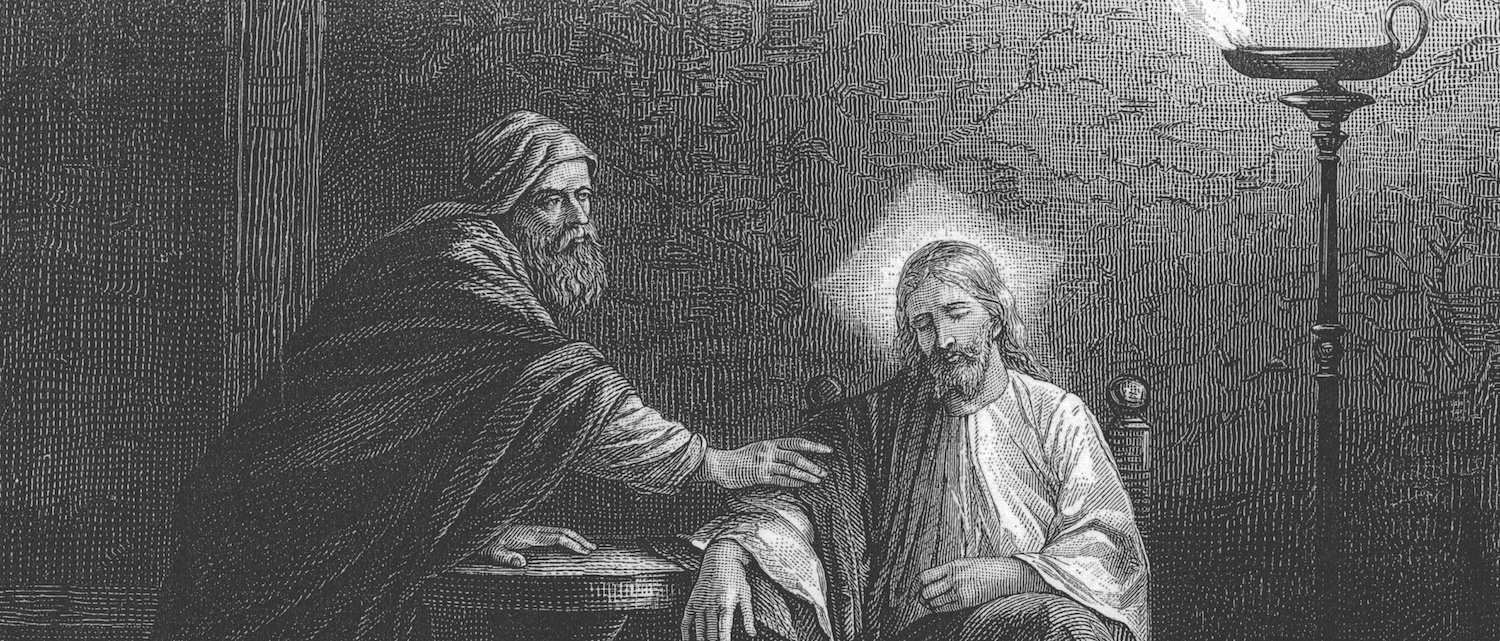
Jesus with Clueless Nicodemus
An important issue to consider is whether the gospel writers grasped the mystical aspect of Jesus’ message. The validity of posing this question is justified on the basis that enough of the mystical thread survives to assume it was an important aspect, if not the entire thrust of Jesus’ original message. Here is another example found in the Gospel of Thomas:
Jesus said, “If your leaders say to you, ‘Look, the (Father’s) kingdom is in the sky,’ then the birds of the sky will precede you. If they say to you, ‘It is in the sea,’ then the fish will precede you. Rather, the kingdom is within you and it is outside you. When you know yourselves, then you will be known, and you will understand that you are children of the living Father. But if you do not know yourselves, then you live in poverty, and you are the poverty.”
Thomas 3
Today’s mainstream Christian looks to the return of Jesus and the literal establishment of God’s kingdom. Though the notion of an inner kingdom that cannot be observed with the eye runs counter to this view, it is a cornerstone of all mystical traditions. The point of contact with this kingdom of God, the spiritual source of every person, is found at the core of the individual. The above passage is well aligned with this foundational principle. To come to know the truth of one’s spiritual source is the key to liberation from the false perceptual restrictions that bind so many of us.
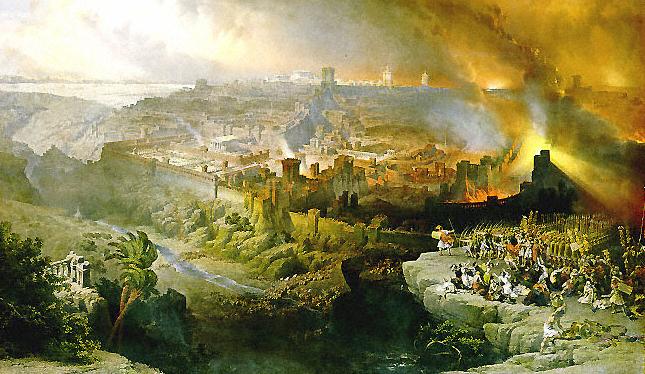
Jerusalem Sacked, 70 A.D.
It is vital to understand that over the four decades since Jesus’ execution, there were dramatic developments in circumstances. Mark is not writing to the world Jesus lived in. The relative peace of Jesus’ day would have been much more conducive to an inner-directed teaching. It is possible that the evangelists understood the mystical aspects of the original teachings, but for reasons already mentioned, made the decision to not give it the attention Jesus intended. Why would they do this? If he spoke of the kingdom in terms of an inner dimension, as I believe he did, such a message, under the dire circumstances of their day, would seem impotent, an impractical abstraction that would do little to defeat the very real enemy. Mark, after all, made its debut in the midst of a very bloody revolution. Would the idea of an inner kingdom of God seem practical when an overthrow of Roman power was the obvious solution? Both Christians and Jews were under savage attack by the Romans. Church leaders were being put to death. To ensure the survival of the Jesus movement, the message the leadership knew their audience needed and wanted to hear was that the Messiah, Jesus, had indeed been here and he would soon return. And when he returned, he would defeat the tyranny and horror of oppression and destroy these enemies of God. This business about an inner kingdom simply would not carry the weight or inspire the hope that the promise of an imminent overthrow would provide.
We can deduce with relative certainty the various audiences and political climates of the four evangelist. However, we can never really know what was in the minds and hearts of those responsible for producing the gospels. What we do know is, like a scattering of jewels, fragments of the mystical element survive, not necessarily by design, but because any one of these collected sayings were likely considered too precious to discard. In creating their accounts, the authors did their best to incorporate all material at their disposal, tweaking the context to align with their own narrative. Luke’s use of the passage on the kingdom within (Luke 17:20-21) is a case in point. He seems to have simply copied and pasted it into a spot where it could fit. Remove it and there is no interruption to the flow of the narrative. This suggests to scholars that this was an independent saying that Luke utilized. Again, the gospel writer’s primary purpose was not to present an accurate historical or biographical account of the life and teaching of Jesus. Their purpose was to advance the story that would inspire the most hope within their own Christian community.
Mark, a Collaborative Effort?
Let us return to Mark, the first gospel to appear. There is general agreement among scholars that Mark was written in Rome, though Galilee, Antioch, and southern Syria have also been suggested. Regardless of where it was written, considering the evangelical nature of the work, I believe the case can be made that Mark was not written by a cloistered scribe working alone in the dim light of an oil lamp. Rather, Mark is the product of a collaborative effort. The image of Jesus that emerges in this gospel is not random. In addition to matching the common Jesus lore of the day, it also aligns with Old Testament prophecy. Its creation would have required considerable research, substantial knowledge of the scriptures, and, in all likelihood, a consensus of agreement among the leadership. Like Paul, the leaders of the Jewish-Christian community in Rome may have employed a scribe to commit their narrative to written form, but it would be they, not the scribe, who would oversee its final draft. The input of multiple contributors may also factor into Mark’s anonymity.
Why this collected material was converted into narrative form and appeared at the time that it did suggests how this conversion may have occurred. As we have seen, the story of Jesus had been circulating orally for forty years. The fluid nature of oral transmission raises the possibility that even before Mark reached its earliest publishable form, the story of Jesus had drifted in meaning to a condition that Jesus himself would not recognize. In addition, multiple versions of an orally transmitted message were being told. The early church leaders probably felt an urgency to resolve this dilemma via published text.
Luke would later address this problem in the preface of his two-volume account, Luke-Acts. He is writing to Theophilus, a character unknown to us, but possibly a wealthy patron who sponsored Luke’s work.
Inasmuch as many have undertaken to compile a narrative of the things which have been accomplished among us, just as they were delivered to us by those who from the beginning were eyewitnesses and ministers of the word, it seemed good to me also, having followed all things closely for some time past, to write an orderly account for you, most excellent Theophilus, that you may know the truth concerning the things of which you have been informed.
Luke 1:1-3
Luke is referring to written narratives, undoubtedly including the Gospel of Mark, which, as we have seen, he used as the basis of his gospel. This was long before intellectual property became a consideration and plagiarism was an accepted practice. The creators of Mark would have been concerned with the variations of stories being told. In Mark’s day, an officially sanctioned guiding document, the first of its kind, would have established a solid, powerful, authorized account.
From a psychological standpoint, I can see Matthew and Luke having advantages that make it easier to attribute a single author to their works. Both are more skilled in the craft of writing, bringing finer detail to their scenes and transitions. Luke-Acts reads like a novel of the period. Mark’s lack of detail and its rapid-fire presentation in general – fifteen scene changes in the first chapter alone – gives it the feel of collective authorship not wanting to get lost in the weeds of detail. Unlike Mark, Matthew and Luke were not burdened by the more difficult task of invention. That they used Mark as their prototype is a clear indication that, whether or not Mark agreed with Jesus, this gospel was sanctioned by the leadership of the Christian community. This was the official direction for Jesus they had decided to take. Yes, there would have been plenty of editorial hurdles for Matthew and Luke to clear, but building their narratives from scratch was not one of them.
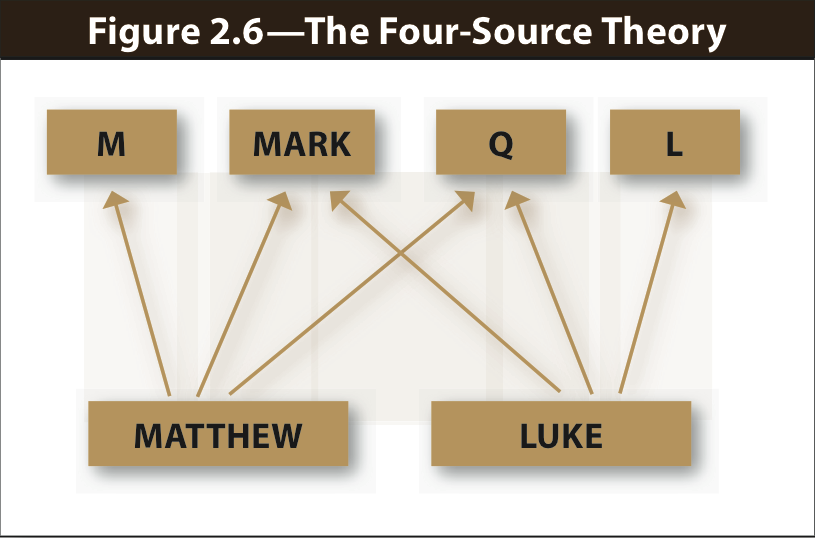
4 Source Theory
Matthew and Luke also had the benefit of scrutinizing Mark for flaws and omissions, like a birth story and post-resurrection appearances. Armed with this information, and additional material not available to the creators of Mark (Q Source, and material specific to Matthew (M) and Luke (L)), these two authors could provide fuller accounts that further clarified the narrative as a whole. Because Matthew, Mark and Luke draw from common sources and represent a similar point of view, they are referred to as the synoptic Gospels. John, which surfaced some years after Matthew and Luke, presents a unique picture of Jesus derived from different sources. Despite their many differences, however, all four gospels reflect a similar meaning of the life and death of Jesus, a meaning that had circulated widely and has since served as the distinguishing basis of the mainstream Christian faith. That said, it should be understood that these separate accounts were never intended to be placed side-by-side as the scriptural basis for a developing religion. Each author had their specific purpose and audience in mind.
In the case of Mark, is it reasonable to think the collection of parables, stories, and possibly written snippets of the oral tradition had fallen into the control of a single writer? It would seem that any collection of such valuable material, well-known within the Christian community, would be held for safekeeping by designated and trusted members of the leadership. If they did pass it to a scribe, I am inclined to think it was by design. In its piecemeal form, this material would leave too much to the interpretive imagination. What was needed was a clear guiding document, developed and approved by those who were in the best position to help forge it. And what document could be better than an authorized, fleshed-out account of the good news, the life and teachings of the Son of God?
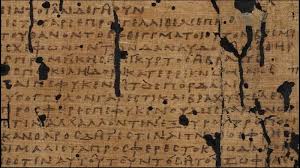
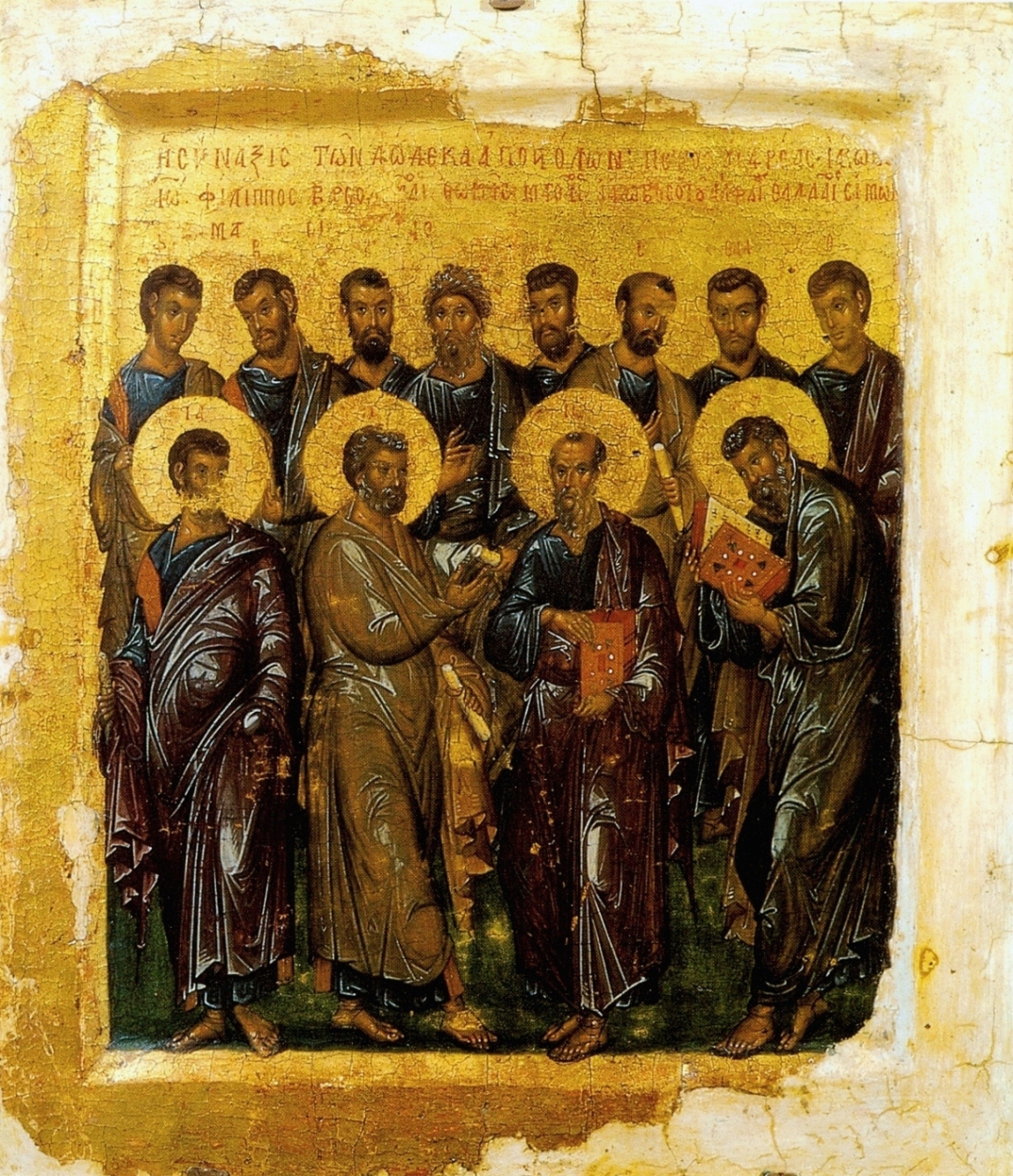
Image of 12 Disciples From the Didache
As a final point to my hypothesis of collective authorship, we assume that documents like The Apostle’s Creed and the Nicene Creed were also anonymous but likely written by a group of men. Another document, the Didache, appeared about the same time as Mark, though not related. Regarded by some scholars as an early form of catechism, the Didache provided guidelines to Christian ethics, rituals, and church organization. Reading through it (you can find the full text online), it is difficult to imagine a single author creating such a guiding document. While the Didache focuses on ritual and proper Christian behavior, Mark’s focus is on the correct way to think of Jesus. Considering the importance of the early church establishing a unified front, it stands to reason that the notable players in leadership would be closely involved in the creation of all defining documents, if not as actual authors, in the very least as key members of the ancient equivalent to the editorial board.
Why would this matter? It would explain how and why the original message of Jesus could be transformed from a mystical, inner-directed teaching to the hope of a futuristic kingdom announced by the anticipated second coming of Jesus. It would also give a plausible explanation of why Matthew and Luke had the confidence to use Mark as their basis, and why John considered its characterization of the life and death of Jesus as worthy of his own adoption. To me, critical scholarship is liberating, but it does not give us license to be irresponsible. This is why I am presenting this idea as a reasonable explanation of how we could have a dual message – one from the church, the other from Jesus – in a single body we know as the canonical gospels and the New Testament as a whole.


 J Douglas Bottorff