The Everlasting Arms

YouTube: The Everlasting Arms

God … is the substance (from sub, under, and stare, to stand), or the real thing standing under every visible form of life, love, intelligence, or power. Each rock, tree, animal, every visible thing, is a manifestation of the one Spirit—God—differing only in degree of manifestation; and each of the numberless modes of manifestation or individualities, however insignificant, contains the whole.” -Emilie Cady

As I read this text, I am reminded of a verse from Deuteronomy:

“The eternal God is your dwelling place, and underneath are the everlasting arms” (Deuteronomy 33:27).

Shifting from the notion that God is a human-like figure who resides in the sky to the understanding that God permeates and sustains all life is a big step for many. And yet as we make this change in our thinking, we come to know God as an imminent help and sustainer in our time of uncertainty. To think of God as our dwelling place and ourselves as being upheld and guided by God’s presence opens our mind to this truth. We take a peaceful, centered approach to our life.

God is your substance and the substance of all you desire. This is a prospering statement, one that helps open your mind to the truth of God as your unfailing resource. Instead of thinking “there are four months to harvest” the truth that God is your ever-present substance opens your mind to the “fields ready for harvest” right now. The same is true with health. God is your present source of health. The healing energy that God is works in and through your mind and body now. 

The statement, I live in God, and God lives in me aligns your thinking with the truth of your relationship to God. Speak these words when you are alone, quietly when you are with others, while you are out for your walk, driving your car, or alone in a meditative setting. Do not reach out to God; reach in. Wherever you are in life, open your mind to God’s prospering, healing presence.
Stand Alone with God

YouTube: Stand Alone with God

Each man must sooner or later learn to stand alone with his God; nothing else avails. Nothing else will ever make you master of your own destiny.”   Emilie Cady

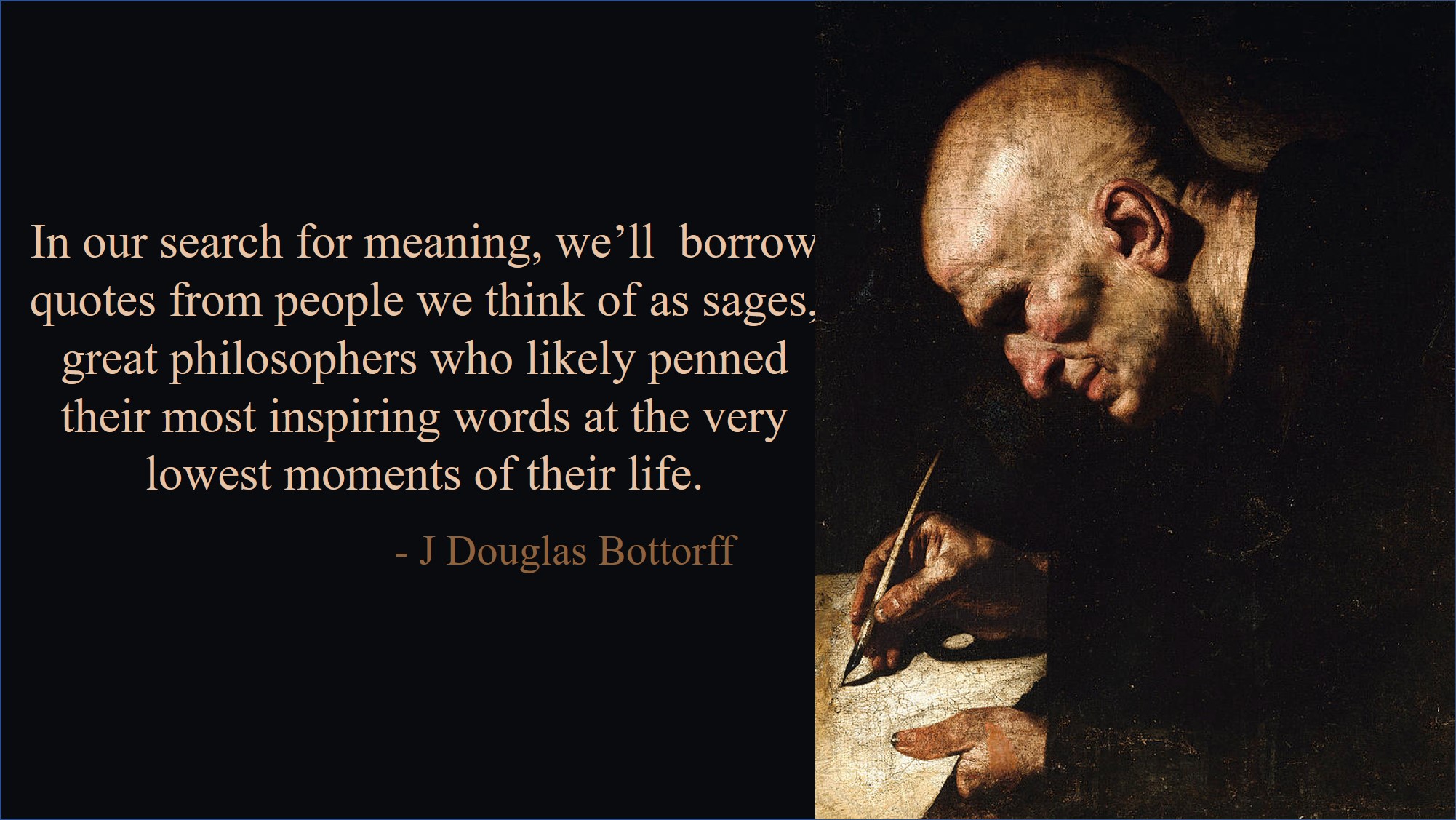
Wouldn’t we all love to have a wise old sage we could turn to in our times of uncertainty, someone we knew who was perpetually grounded in spiritual principle, unperturbed by the ever-changing world of appearances? For me, this person has been Emilie Cady. Often, in my own time of uncertainty, some reassuring phrase of hers comes to me with renewed relevance to my concern.

In this case, her words of wisdom suggest turning from sages to our own indwelling God, which is the true role of the sage. They are there to remind us of the spiritual path to freedom, a path we thought was blocked by some very real-appearing obstacle. She would be the first to say that it is not enough to simply acknowledge the sign that the sage holds. With these words, we are reminded that we must actually take the stand, turn from peace-robbing appearances, and unite in thought and feeling with our God of courage and the strength to become masters of our destiny.

Our destiny is freedom from fear and failure. To stand alone with our God is to find our center of power and to reach the unshakable conviction that the highest good is now unfolding through our life. As a statement that can help us recenter our trust in God, Cady suggests a statement like this: God is my defense and deliverance. As we speak such words, we feel the healing balm of their truth dissolve the darkness and bring forth the light, that we may move through our days and nights in confidence and in peace.

If you are experiencing a moment of uncertainty, go alone, let go of all appearances and speak these simple words: God is my defense and deliverance. Speak them quietly until you feel the shackles of fear fall away. Any time throughout your day the darkness of fear attempts to overtake you, speak them again until you know you are standing alone with your God. Your destiny is freedom, and your freedom is now.   

Monsters, Saints, and Peanut Butter Kisses

YouTube: Monsters, Saints, and Peanut Butter Kisses

In my brief research of Halloween, I discovered that some historians believe it can be traced back into ancient, Celtic speaking countries and was later Christianized, possibly as the Church’s way of appeasing the pagan audience it was set on converting. Other historians say it originated as a Christian holiday. Halloween has been connected with everything from Pomona, the goddess of fruits and seeds, to Parentalia, a festival of the dead, to the Celtic festival of Samhain, which comes from the Old Irish for summer’s end. From the personal standpoint of a child, I only saw it as an opportunity to disguise myself and hit up the neighborhood for a boatload of free candy.

I have to confess that, as one involved in a career that encourages people to drop the costume of self-image, learn to master our terrorizing thoughts, and let go of the attitude of, give me what I want or else you may not like what I do to you, I find very little of spiritual value in this holiday. I don’t need to light candles to remember or honor departed souls. The thought of worshipping relics of saints (like a shriveled, mummified hand) grosses me out. I don’t normally celebrate summer’s end. I’m not fond of horror films. And the lack of willpower to refrain from eating an entire bag of peanut butter kisses only showcases my human frailty. If there is a Halloween version of scrooge, I guess that would be me.

Yes, families do get together and celebrate on Halloween. It’s our annual chance to share a friendly meal with Frankenstein, the Werewolf and the Mummy. But many families already bear a strong resemblance to the Munsters, so I’m not sure there’s a net benefit here.

Perhaps Halloween could be construed as a formal way of confronting our deepest fears. Learn to have fun with the thing you fear most, and you may realize there is nothing to fear. Isn’t this a technique for confronting fear? Come up with the worst-case scenario, that monster lurking in the shadows of your mind, and then you work with it until you bring it into the light and no longer fear it.

So, in whatever way you choose to celebrate Halloween, have fun and be safe.

Have We Met?

YouTube: Have We Met?

When Jesus said, “My sheep hear my voice,” he was not suggesting that his followers were mere sheep, nodding in mindless agreement with every word he spoke. He was saying that those who naturally and deeply resonated with his message were doing so at the soul level. Those who were beginning to awaken to the truth of their being would hear and respond to his message.

We all meet many people in our life. There are some with whom we have an instant rapport, as if we are connected at a level that transcends the surface facts of the relationship. Is it possible we’ve known one another in a previous life? Those who embrace the notion of reincarnation are probably familiar with the idea of souls traveling through lifetimes in groups. I suggested this in one of my songs, It Never Ends:

You and I have walked before

together on some distant shore

do we know some ancient lore

together as friends?

Though I believe Beth and I have walked before, together on some distant shore, I personally don’t put much energy in the pursuit of tracing the time and place of our former relationship. I simply accept that our meeting this time was not our first. Nor should it be surprising that a common, heartfelt interest in spiritual things would cause our paths to cross yet again. Even through this earthly life, we stay in touch with those kindred spirits whose company immediately fit us like comfortable clothing.

I also find comfort in the idea that even when a meaningful relationship is brought to a momentary close, the opportunity to resume will present itself at the appropriate time and place. Parting company is not easy, but as we lift our spiritual eyes to the larger context of this playing field we call life, we can know that nothing precious is ever lost. As Kahlil Gibran so beautifully wrote,

“A little while, a moment of rest upon the wind, and another woman shall bear me.”

What I recognize as precious now, I will surely know as precious then.

Follow-up on Forgiveness

When Jesus said, You will know the truth and the truth will make you free, he was addressing the key to understanding the ultimate objective of forgiveness: freedom. We not only want to be free of the hurtful actions of others, we want to be free from our own self-destructive attitudes. Whether we are talking about forgiveness of another or self-forgiveness, it’s very helpful to see it as our means of reclaiming the freedom of our wholeness.

If this sounds self-serving, just remember that you give the most when you are living your life from strength. I say often that God expresses through us as life, love, power and intelligence. Spiritual power manifests as strength, a quality that is our spiritual birthright. The act of forgiveness is really the act of reclaiming our spiritual strength.

Think about this for a moment. What does it mean to feel hurt? What does it mean to feel deceived? What does it mean to think of another as having power to make you suffer? If God is your source of power, then how could the actions of another take the power that only God can give? The truth that sets us free is the understanding that this is not possible. Forgiveness is the conscious act of returning to this truth. We’re not attempting to condone the negative actions of another. We are making the choice to return to our true source of power.

Many relationships are based on need. I think you have something I need–usually love in one of its many forms–that affirms me, that makes me feel complete. One day you become angry with me and threaten to withhold your love. So I ask your forgiveness with the hope that you will again give it to me, as my life is not complete without it.

Is this forgiveness, or is it a form of manipulation? Am I dealing with our situation from a place of strength or from a place of weakness? Am I seeing myself as an expression of God, or do I see others as holding the key to my wholeness?

There’s a story of a farmer who lived outside a village. On his land was an artesian well. One day the village well dried up for reasons no one knew. The farmer gladly began sharing his water. But then he became greedy and started charging the villagers for the water they took. His fee kept climbing. If someone complained, he would either raise their fee or cut them off. Only as they begged his forgiveness would he allow them to continue to get water, and at the price he set. Then, a certain villager realized that if they dug just a bit deeper, they could once again tap the aquifer, which they did. As the village reclaimed its water supply, the farmer’s scheme was rendered useless.

In this story, the truth that set the village free was found within their own well. What they had thought of as forgiveness was really a form of manipulation on the part of the farmer. Reclaiming their own water source once again put them in a position of strength. Knowing his greedy character, they could easily let go of the farmer for he no longer had the ability to manipulate them.

If you are struggling with forgiveness, it may very well be that you need to dig a little deeper into your own well. It might seem that another is controlling your water supply, but in truth, your source of power is never depleted. Isn’t this what Jesus was saying when he suggested that we seek first the kingdom of God and all else would be added? Find your own water supply, your own fountain of power, and the rest falls in place. When you tap your own spiritual strength, you will no longer need to forgive, for you will know that no one can take from you that which is yours already.

The Forgiveness Principle

YouTube: The Forgiveness Principle

I will give you the keys of the kingdom of heaven, and whatever you bind on earth shall be bound in heaven, and whatever you loose on earth shall be loosed in heaven” (Matthew 16:19).

Peter once asked Jesus how many times a person should forgive someone who had sinned against them. Seven times? Jesus said, seven times seventy. It’s important that we become completely free of the actions of another. Why? The answer is found in the above passage: What we bind on earth, is bound in heaven. In other words, our fixed state of mind has a corresponding influence on the way our life unfolds.

How do we loose an offender that we feel has damaged us in some way? How do we forgive? We start with the realization that they have no power to diminish us. Our negative response toward them is the only thing that hurts us. Forgiveness is taking back the power we have given them.

Forgiveness has nothing to do with condoning or overlooking the bad behavior of another. To forgive someone does not mean you have to throw your arms around them. It means that you see yourself in a new light. Despite their intention, you are still whole, completely unscathed by anything they have said or done. Free yourself of the notion that they have taken something from you, for they can only take what you are willing to give. Again, what you bind on the earth of your own thinking will have a corresponding influence somewhere in your life.

When Joseph’s brothers sold him into slavery, he acknowledged that they meant evil toward him. But he was able to rise above their intentions by focusing on the greater good that ultimately came about for him. Though we would likely think he was justified in doing so, he did not allow their negative actions to diminish him. He did not bind himself to their low intentions with resentment.

If you are struggling with negative feelings around the actions of another, know the ball of forgiveness is always in your court. Loose them and let them go. In doing so, you are freeing yourself.

Apocalypse

Youtube: Apocalypse

But in those days, after that tribulation, the sun will be darkened, and the moon will not give its light, and the stars will be falling from heaven, and the powers in the heavens will be shaken. And then they will see the Son of man coming in clouds with great power and glory” (Mark 13:24-26).

The thirteenth chapter of Mark, from which this passage is taken, is known as The Little Apocalypse. It bears the same characteristics found in the Old Testament book of Daniel and in the New Testament’s Revelation. It is part of a literary genre known as apocalyptic writing. Many critical scholars believe this chapter was inserted sometime after Mark’s gospel appeared, perhaps just prior to or soon after the Romans destroyed Jerusalem and burned down the temple in 70 A.D.

Apocalyptic writing depicts cataclysm on a cosmic scale. It is always aimed at the demise of an oppressor and the ultimate liberation of the oppressed. In the case of Mark and Revelation, the oppressor was Rome. Daniel’s oppressor was Persia.

It’s important to point out that the purpose of an apocalyptic message is to encourage the persecuted to hold fast to their faith, that things are about to change. Mark’s apocalypse clearly points this out: “Truly, I say to you, this generation will not pass away before all these things take place” (13:30). 

To use any aspect of scripture as a prophetic roadmap through current events is to ignore the historical context and literary nature of apocalyptic writing. The writer is always directing his message to the persecuted of his day. And the message is always, “Yes, it’s tough, and it’s going to get tougher. But hold fast, your day of salvation is about to dawn.”

From a spiritual point of view, the apocalypse occurs within the individual who begins to awaken to their own divinity. A great battle occurs between the old, material-based belief system and the new understanding that we and the world we inhabit are spiritual in nature. The old body-based consciousness is challenged by the unfolding understanding that, as spiritual beings having a human experience, there is infinitely more to us than what transpires between the bookends of physical birth and death. The son of man coming in clouds with great power and glory, is not a reference to Jesus. The son of man is the human being now seen in the light of profoundly clear spiritual understanding.

For God So Loved the World

YouTube: For God So Loved the World

For God so loved the world that he gave his one and only Son, that whoever believes in him shall not perish but have eternal life.” John 3:16

John 3:16 is probably one of the most often quoted passages as a concise summary of the mainstream Christian message. It is used as a reference to Jesus’ sacrifice on the cross for the salvation of the believer. Not all prominent Christians have accepted this interpretation, however. German theologian, philosopher and mystic, Meister Eckhart, took a more internally directed approach to the Only-Begotten.

“This is what the text means: ‘God has sent his Only-Begotten Son into the world.’ You must not by this understand the external world in which the Son ate and drank with us, but understand it to apply to the inner world . . . So truly does God give the Son birth in the most inward part of the spirit, and that is the inner world. Here God’s ground is my ground, and my ground is God’s ground. . . Whoever has looked for an instant into this ground, to such a man a thousand marks of minted gold are no more than a counterfeit penny.”  Meister Eckhart

When viewed from this perspective, God is perpetually giving his only Son to “the most inward part” of each one of us. In the opening chapter of John, he refers to this as the Word, pointing out that all things are made through this mystical impartation. The Son is to God what the sunbeam is to the sun. What Eckhart calls God’s ground, German philosopher Paul Tillich called the ground of Being. John says this impartation of the living Son is an act of absolute love, “For God so loved the world…” In other words, we are not born in sin. We are born out of God’s love of expression.

You’ll never persuade a Christian mainstreamer that this oft-quoted passage has more personal implications. Knowing your very existence is an expression of divine love should help set you free from any guilt around the thought that someone had to suffer and die on your behalf, simply because you were born.  

Spiritual Enlightenment Revisited

YouTube: Spiritual Enlightenment Revisited

 The kingdom of heaven is like treasure hidden in a field. When a man found it, he hid it again, and then in his joy went and sold all he had and bought that field. Matthew 13:44

A key to understanding Jesus’ use of the word heaven lies in its reference to the vast expanse of the open sky. We get the best feeling for this vastness under a clear night sky filled with stars. If Jesus was referring to the sky, however, he would not also have compared it to a hidden treasure. There is nothing hidden about the sky.

The kingdom of heaven refers to our inner connection with the Infinite. It truly is like a treasure hidden in the field of our inner being. It is within the reach of any who recognize where to look and then become open-minded enough to engage in the process of finding this inner kingdom. When this connection becomes clear to us, we undergo the process of selling our possessions, our pre-conceived notions about God, ourselves, and our place and purpose in life. We eventually begin to experience this kingdom we seek.

As we consider the meaning of the term, spiritual enlightenment, the parable offers two possibilities. The first is when the man finds the treasure, the second when he finally buys the field. Most would probably associate ownership of the field with the enlightened state. This would indicate the permanent condition that we strive for.

The problem is, we’ve been striving for ownership of this field ever since we began our spiritual quest. Many see spiritual enlightenment as a condition that, with enough study and work, they will one day achieve. But let’s switch our focus to the man who discovers the treasure and knows where it is hidden. Is this man not enlightened? He certainly is. He’s enlightened enough to recognize the value of the treasure, to know where it’s located, and to know what to sell in order to acquire the field.

Does this not describe you? You know you’re on a quest for Self-discovery, you know to look within, and you are aware of the things you need to let go when they interfere with your quest.